
Introduction
Advancements in medical technology have transformed the way orthopaedic surgeries are performed today. One of the most significant innovations is Computer-Assisted Orthopaedic Surgery (CAOS). This technology has revolutionized joint replacement, trauma care, and sports injury treatment by improving surgical precision, reducing complications, and enhancing patient recovery.
At advanced orthopaedic centers like KS Ortho Care, computer-assisted surgery plays a vital role in delivering accurate, personalized, and long-lasting treatment outcomes.
What Is Computer-Assisted Orthopaedic Surgery (CAOS)?
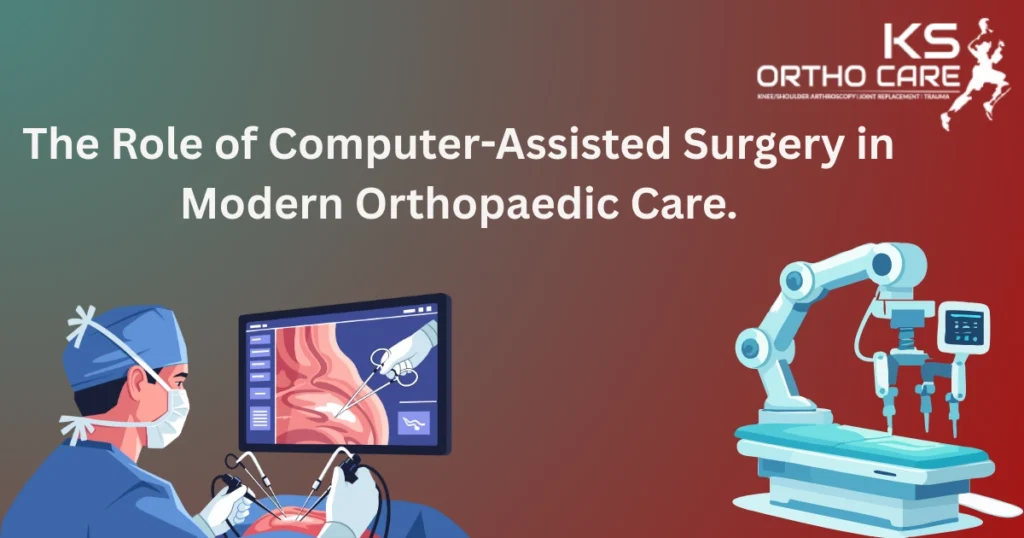
Computer-assisted orthopaedic surgery is an advanced surgical technique that uses digital imaging, sensors, and computer navigation systems to guide surgeons during procedures. It creates a real-time 3D model of the patient’s joint or bone structure, allowing the surgeon to plan and execute the surgery with exceptional accuracy.
Unlike conventional surgery, CAOS helps surgeons visualize anatomy in detail before and during the procedure, leading to more predictable and safer outcomes.
How Computer-Assisted Surgery Works?
The computer-assisted surgery system functions through a combination of imaging and navigation technology:
- Preoperative Planning
Detailed scans such as CT or MRI are used to create a 3D digital map of the joint. - Real-Time Navigation
During surgery, sensors track the position of surgical instruments and display them on a computer screen. - Precise Implant Placement
The system guides the surgeon to position implants with millimeter-level accuracy. - Continuous Feedback
The surgeon receives real-time feedback to ensure proper alignment and balance.
This level of accuracy is difficult to achieve with traditional surgical techniques.
Benefits of Computer-Assisted Surgery in Orthopaedics.
- Improved Surgical Precision
Computer-assisted orthopaedic surgery ensures accurate alignment of bones and implants, reducing the risk of errors.
- Better Implant Longevity
Correct positioning leads to less wear and tear, improving implant life.
- Reduced Tissue Damage
Minimally invasive techniques preserve muscles and ligaments, resulting in less pain.
- Faster Recovery
Patients experience shorter hospital stays and quicker rehabilitation.
- Lower Complication Rates
Better planning reduces risks such as implant loosening or imbalance.
Because of these benefits, computer-assisted surgery is now widely used in knee replacement, hip replacement, spine surgery, and sports injury treatments.
Applications of Computer-Assisted Orthopaedic Surgery.
Computer-assisted orthopaedic surgery is commonly used in:
- Robotic knee replacement surgery
- Total and partial knee replacement
- Hip replacement surgery
- Spine surgeries
- Ligament reconstruction
- Complex trauma cases
It is especially beneficial for patients with severe arthritis, deformities, or previous joint surgeries.
Why Computer-Assisted Surgery Is the Future of Orthopaedics?
The future of orthopaedic care lies in precision-based treatment. Computer-assisted surgery allows surgeons to deliver consistent results with higher accuracy and fewer complications.
With advancements in robotics, artificial intelligence, and real-time imaging, CAOS continues to redefine modern orthopaedic care by offering:
✔ Personalized treatment planning
✔ Higher surgical success rates
✔ Faster patient recovery
✔ Improved long-term outcomes
At KS Ortho Care, we use advanced computer-assisted orthopaedic technology to ensure the highest standard of care for every patient.
Frequently Asked Questions (FAQ)
- What is computer-assisted orthopaedic surgery?
Computer-assisted orthopaedic surgery uses digital navigation and imaging systems to help surgeons perform precise and accurate surgical procedures.
- Is computer-assisted surgery safe?
Yes. It is extremely safe and reduces the risk of surgical errors by providing real-time guidance during surgery.
- How does computer-assisted surgery improve recovery?
It minimizes tissue damage, reduces pain, and allows faster healing compared to traditional surgery.
- Is computer-assisted surgery used in knee replacement?
Yes. It is widely used in robotic knee replacement surgery for accurate implant placement and better long-term results.
- Who is suitable for computer-assisted orthopaedic surgery?
Patients with arthritis, joint damage, sports injuries, or those requiring joint replacement can benefit from computer-assisted surgery.